Sunday, July 11, 2010

Scripting Segue

At San Francisco State, all courses transferred and all courses applied to your major are tracked in a DARS report.  It's really powerful and intuitive tool to help you assess your academic standing.  The problem though arises when you have a ton of courses transferred from different institutions, it gets quite messy and time consuming.

I thought that this should be a good solution to practice scripting in Perl, and so I embarked and after about 3 days of on and off coding, I perfected my script.  It takes the DARS report from its web format (HTML), filters, sorts, and outputs the result into a format usable in an Excel spreadsheet.

In the end of the endeavor, I found that the totals in the Unofficial Transcript (another report that actually shows your GPA) was accurate.  But now I know precisely how much effort is needed to nudge up my GPA, and I can toy with projections on a Spreadsheet.

If any other business students do these types of activities, I'll be surprised.  Ultimately though, the gain from all this is that my skills are sharper...

Tuesday, June 1, 2010

Corporatism

In my studies at Yonsei (ISM 2107 Politics and Business in Korea), and recently at a course I took on the side POLS 18 Government and Politics of Latin America at CCSF, I have often come across this term called corporatism

I'm like what exactly is this?  So, during class, I looked up the definition on my Android, and found the Wikipedia entries as defined by political scientist:

  • corporatism (political scientist definition) - the process of licensing and regulation by a state for incorporating social, religious, economic, or popular organizations into a single collective body.
  • state corporatism (political scientist definition) - states co-opt business leadership, or circumscribe the ability to challenge state authority by establishing organizations as the source of their legitimacy, or by governing the state through corporations.
In Latin American politics, the general term is used, but in East Asian politics, particularly Korea, the state-corporatism definition is used when referring to the term.  Wikipedia also lists these definitions:

  • corporatism - system of economic, political, or social organization that views a community as a body based upon organic social solidarity and functional distinction and roles amongst individuals (http://en.wikipedia.org/wiki/Corporatism)
  • state corporatism - a political culture which is a form of corporatism whose adherents hold that the corporate group which is the basis of society is the state (http://en.wikipedia.org/wiki/State_corporatism)
However, of all the terms, I have to love Apple's Dictionary on Mac OS X, which lists:

  • corporatism - the control of a state or organization by large interest groups.

    Holland's Hexagon

    I was digging through my notes and found this scrap of paper for a course I took at Foothill (CLRP 70 Self Assessment).  On the scrap was this theory RIASEC Theory or Holland's Hexagon (http://en.wikipedia.org/wiki/RIASEC). This represents six distinct personality types and potential matching careers for those personality types.  There's a relation between people and their environment, and when they are working in the environment, they can get the most enjoyment from their job.


    In reading one website, called the Career Key (http://www.careerkey.org/asp/your_personality/hollands_theory_of_career_choice.html#twist), they noted that most people are multiple types,  and should find compatible careers, where the job involves related job types (that is to the left or right of the hexagon angle). 

    Given that many new jobs these days are requiring cross-field experience, such as project management with technology (software engineering or information technology), this might be important to evaluate personality types for the best match.

    Sunday, May 30, 2010

    Marketing Orientation and VMWare

    One company that was always a pioneer in the market space of virtualization is VMWare.  I have been a user of their VMWare Workstation products, and on the Macintosh, a user of VMWare Fusion.  Recently, the latest version of the Mac version, Fusion 3.0, is riddled with bugs, loss of features from previous version, and degraded performance.  They did a major overhaul in with recent bug fixes, but I'm still seeing many bugs.

    At the trade show MacWorld, I dropped by the VMWare booth, and all I found there were mostly sales or marketing that know the basics about the product.  I asked one to demonstrate a stable feature, dragging items from the desktop in Windows to Mac, in front of an audience, and much to his chagrin, the feature didn't seem to work.

    This got me to thinking, is VMWare disconnected from the customer.  I recall long ago that there were technical people that attended trade shows, but now I am seeing those that make the product so far removed with what seems layers of management.  I can only guess, as I don't work there, but if the severe, what I personally feel, is misalignment in customer requirements for their 3.0 release combined with quantity and severity of bugs in the release, I have to consider there's something amiss at VMWare.

    So I did some sleuthing on the Internet and found this at my first glance:

    What the Hell is Market Oriented

    In the Marketing class that I took at Yonsei (BIZ1102 Marketing in Fall 2008 taught by Dr. Seigyoung Auh) I came across this concept of Market Oriented.  This is where the marketing is incorporatied horizontally across an organization and where every function has an understanding of the customer.  This is quite different that many companies that segregate and isolate people into functional groups like marketing, sales, finance, engineering, etc.  and use serial communication, which is like throwing a brick over a wall with a message attached.

    The article that was amazing, problably required reading for every good marketing class is: What the Hell Is "Market Oriented"? by Benson P. Shapiro, found in the Harvard-Business-Review in Nov-Dec 1988 edition:


    This article is absolutely timeless, and I see countless examples of companies that are so disconnected from the customer, such as excluding developers and software quality assurance from attending trade shows.  Many times I have gone to conventions, and dealt with those that either don't care about the development or quality of a product they are trying to sell, or they simply do not have the knowledge or connections to enact change that could improve a product.

    Saturday, May 29, 2010

    The Missing Link is Design

    Ever since I was a child I was creating huge theme parks, designing businesses, imagining huge systems. Active imagination is good, because you can discern how to use what you learn. There's a certain finesse in creating things, works of art in any profession.

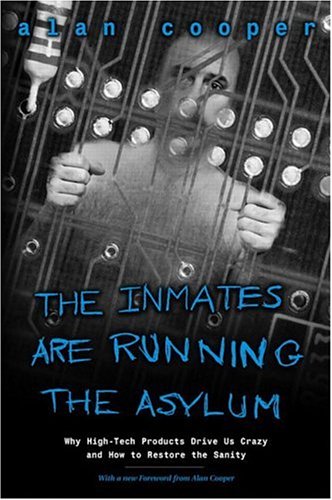
    As I navigate between the roads of technology and business, modeling ideas and design architectures I am discovering are sought after skills, and this is my core talent. And I came across a book that puts it all together, the proverbial missing link.

    This is The Inmates Are Running the Asylum: Why High-Tech Products Drive US Crazy and How to Restore the Sanity by Alan Cooper. Here he shows how many of the things I'm learning in my business college are obsolete, as far as accounting and operational systems that are oriented toward manufacturing and come from the industrial era long ago. Now we are on a new age, the Information Age, and these outdated old models don't work. In any event, this is a fun read, definitely challenges one's way of thinking to accept a new way, and learn about delivering products that people not only need, but actually enjoy to use.

    Tuesday, May 25, 2010

    Segment III GE in South Korea

    In a California State University, you have to take general education curriculum to get an undergraduate degree.  These are divided into three segments, where Segment I and II can be completed at the community college.  Segment III, is upper division only, meaning the junior and senior years of one's education.  Segment III requires three courses covering culture, ethnic, and social diversity.

    Well, what better way to get "culture, ethnic, and social diversity" than to travel to the actual country!  At SFSU, you can fulfill this requirement through a study abroad: http://www.sfsu.edu/~studyabr/CSUIPandSFStateBilateral/CSUIPAndSFStateBilateral.html.

    So this is what I did, I traveled to Korea, and I had an amazing experience in not only understanding Korean culture (as it's changing and evolving), but also understanding American culture.  I also developed stronger research and analytical skills, and gained a deeper perspective into a fields of business, economics, anthropology as well as culture, politics, and history within East Asian region and how it relates to the developing changes in the world at large. 

    Now, I can officially check this part of my requirements off, and open the door to new opportunities in life from this new understanding I gained in life from my voyage to Korea.